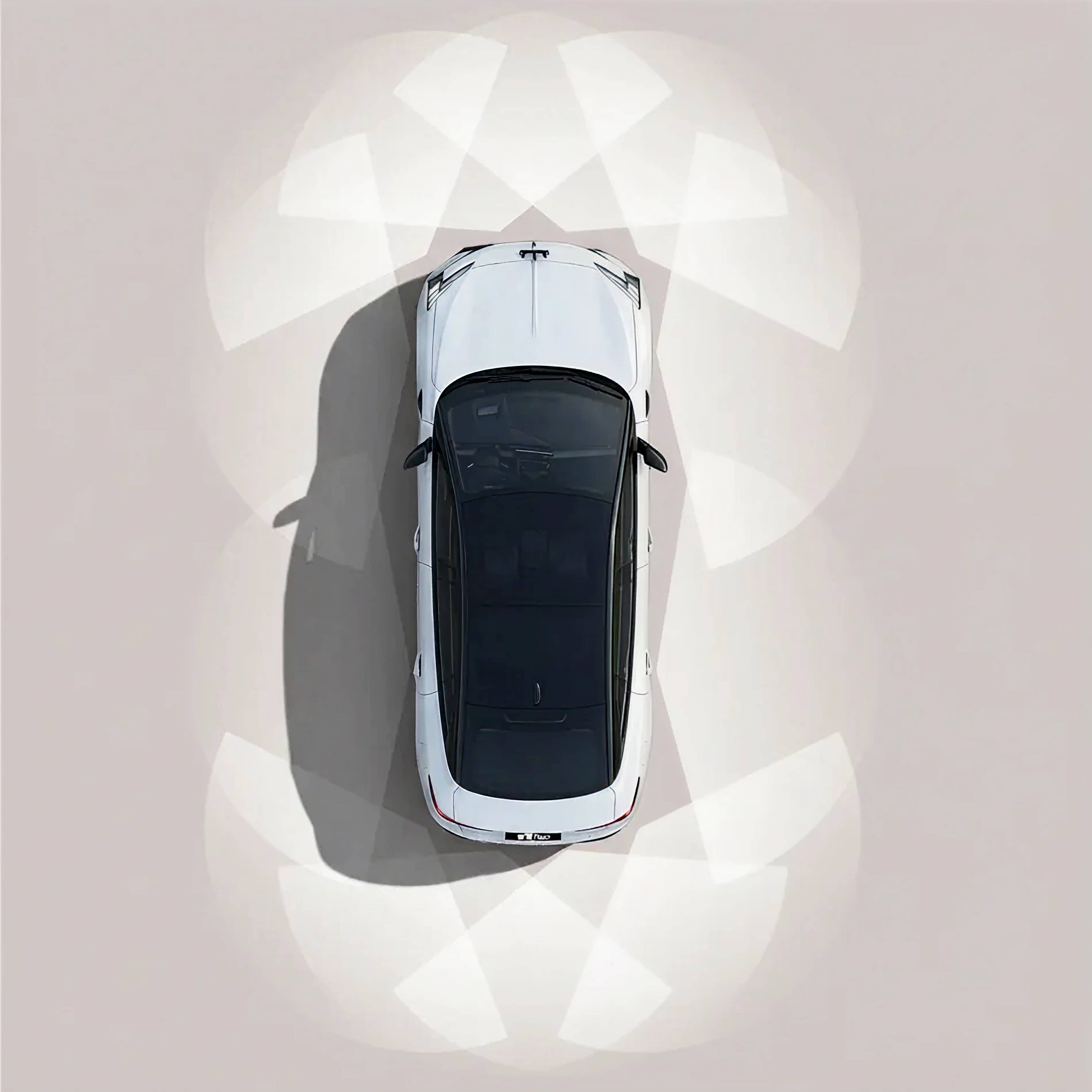
Where physics drives
industrial autonomy

Ai Robotics (AiR) delivers the world's first efficient, auditable,and rapidly deployable autonomous driving technology.
ABOUT AI ROBOTICS
Founded in 2016 in Singapore, Ai Robotics has pioneered a fundamentally different approach to mobility using our proprietary First Principles Technology (FPT) based solution — a physics-based method that doesn’t rely on massive datasets or cloud infrastructure.
Our technology
Leveraging this technology, Ai Robotics has completed over 10,000 commercial autonomous trips across geofenced environments, demonstrating rapid deployability and a strong safety record without reliance on GPS or HD maps.
Our vehicle-agnostic system is designed to retrofit existing platforms with Level 4 autonomy, making scalable and cost-effective autonomous mobility solutions accessible across industries.
BUILT DIFFERENT, DESIGNED TO SCALE
Conventional AV systems rely on vast data and complex algorithms, but their models are not understood or explained. As a result, adoption relies largely on accumulating statistical evidence of safe operation.
No HD Maps Required
Works Without Cloud,
GPS, or Network
Deployable on Any Vehicle in Weeks
10,000+ Commercial Trips Completed with
0 Incidents

AiR’s FPT-powered Physical AI system mimics how humans perceive and act in physical environments — through geometry, physics, and situational awareness, not just neural nets.

Industries

AiR reshaping
industrial autonomy

Autonomy handles repetitive transport routes more efficiently and safely, reducing labor costs and human error.
Short-distance, high-frequency shuttle routes are ideal for efficient and economical autonomous vehicles.
Remote, dynamic, or GPS-denied environments are where AiR’s FPT- based autonomy outperforms traditional systems.
Reliable, self-driving transport enables independence where driver shortages and safety concerns are growing
Core Differences

The core tech stack enabling
first-drive autonomy

-

Standard Deep Learning Stack

AiR First Principles Architecture

Decision logic

Probabilistic "Black Box"

Heavily dependent on GPS, cloud connectivity, and pre-scanned HD Maps.

Deterministic "Glass Box"

Invariant physical laws and geometric derivation. Every decision is deducible from first principles.

Localization source

Absolute positioning

Heavily dependent on GPS, cloud connectivity, and pre-scanned HD Maps.

Geometric invariance

Infrastructure-free Perception. Navigates via relative curvature and inertial constraints, even in GPS-denied zones.

New site adaptation

Data intensive

Requires months of data collection and model retraining for every new environment.

Universal admissibility

Understands physics instantly. Validates traversability without prior data or training.

Safety validation

Statistical confidence

"99.9% accurate" but prone to silent failures
in novel edge cases.

Holonomic & non-holonomic constraints

Safety bounds ensure the vehicle physically cannot command an unsafe trajectory.

Training overhead

Big data dependent

Requires massive labeled datasels to improve performance.

No training required

Performance is derived from fundamental constants and constraints, not data volume. No "garbage in, garbage out" risk.

Decision logic

Standard Deep Learning Stack

Probabilistic "Black Box"

Statistical guesswork based on training data correlation. Difficult to explain failures.

AiR First Principles Architecture

Deterministic "Glass Box"

Invariant physical laws and geometric derivation. Every decision is deducible from first principles.
Localization source

Standard Deep Learning Stack

Probabilistic "Black Box"

Statistical guesswork based on training data correlation. Difficult to explain failures.

AiR First Principles Architecture

Deterministic "Glass Box"

Invariant physical laws and geometric derivation. Every decision is deducible from first principles.
New site adaptation

Standard Deep Learning Stack

Data intensive

Requires months of data collection and model retraining for every new environment.

AiR First Principles Architecture

Universal admissibility

Understands physics instantly. Validates traversability without prior data or training.
Safety validation

Standard Deep Learning Stack

Statistical confidence

"99.9% accurate" but prone to silent failures in novel edge cases.

AiR First Principles Architecture

Universal admissibility

Safety bounds ensure the vehicle physically cannot command an unsafe trajectory.
Training overhead

Standard Deep Learning Stack

Big data dependent

Requires massive labeled datasels to improve performance.

AiR First Principles Architecture

No training required

Performance is derived from fundamental constants and constraints, not data volume. No "garbage in, garbage out" risk.
Engineered Awareness

Experience the future of AI perception – awareness engineered

A real, proven breakthrough in AI — designed for scale, engineered for impact. AiR is deployment - ready and can integrate seamlessly into auto-grade hardware within weeks of evaluation. We invite you to try it first-hand today.
Led By Experience, Built For the Future
Backed by an elite team of PhDs and engineers specializing in physics, mathematics algorithms, sensor fusion, systems quality, and security — AiR is built to deliver at scale.
CEO
Debajit Das
Veteran tech leader and former FTSE 100 board executive, Debajit built a $1B+ Asia-Pacific business and now leads AiR’s mission to redefine mobility.
COO
Wu Ran
Seasoned operational expert, WuRan brings decades of crossindustry experience to scale AI deployments across global markets.
CTO
Suvajit Das
AI pioneer since the early 2000s, Suvajit blends deep technical experience with entrepreneurial success, including a previous company acquired by Andritz.
LET`S WORK TOGETHER

Join us in building the future
of industrial autonomy

Contact us